Showing posts with label descriptive ability. Show all posts

Monday, July 15, 2013

Coleman's Camp - SUMMER 2013

Coleman's Camp, 5th week: TUESDAY (no THURSDAY due to 4th of July)
  • Continued filming segments for video to accompany song
  • Reading lyrics and discussing meaning
  • Brainstorming methods to represent each segment of lyrics
  • Exploring, practicing, and refining facial expressions and gestures to emote
Coleman's Camp Studio, 5th week: SATURDAY
  • Recording Toontastic video
  • Sharing of items and special skills, talents, and interests
  • Organizing supplies


Monday, June 24, 2013

Coleman's Camp - SUMMER 2013

Coleman's Camp, 2nd Week: TUESDAY
  • Creating Cubic Meter structure in teams with meter sticks and duct tape
  • Problem Solving construction issues of tape and support
  • Devising Obstacle Course for teammates to traverse while dealing with certain limitations, such as eyes closed, no verbal communication, or understanding hand gestures for navigation
Coleman's Camp, 2nd Week: THURSDAY

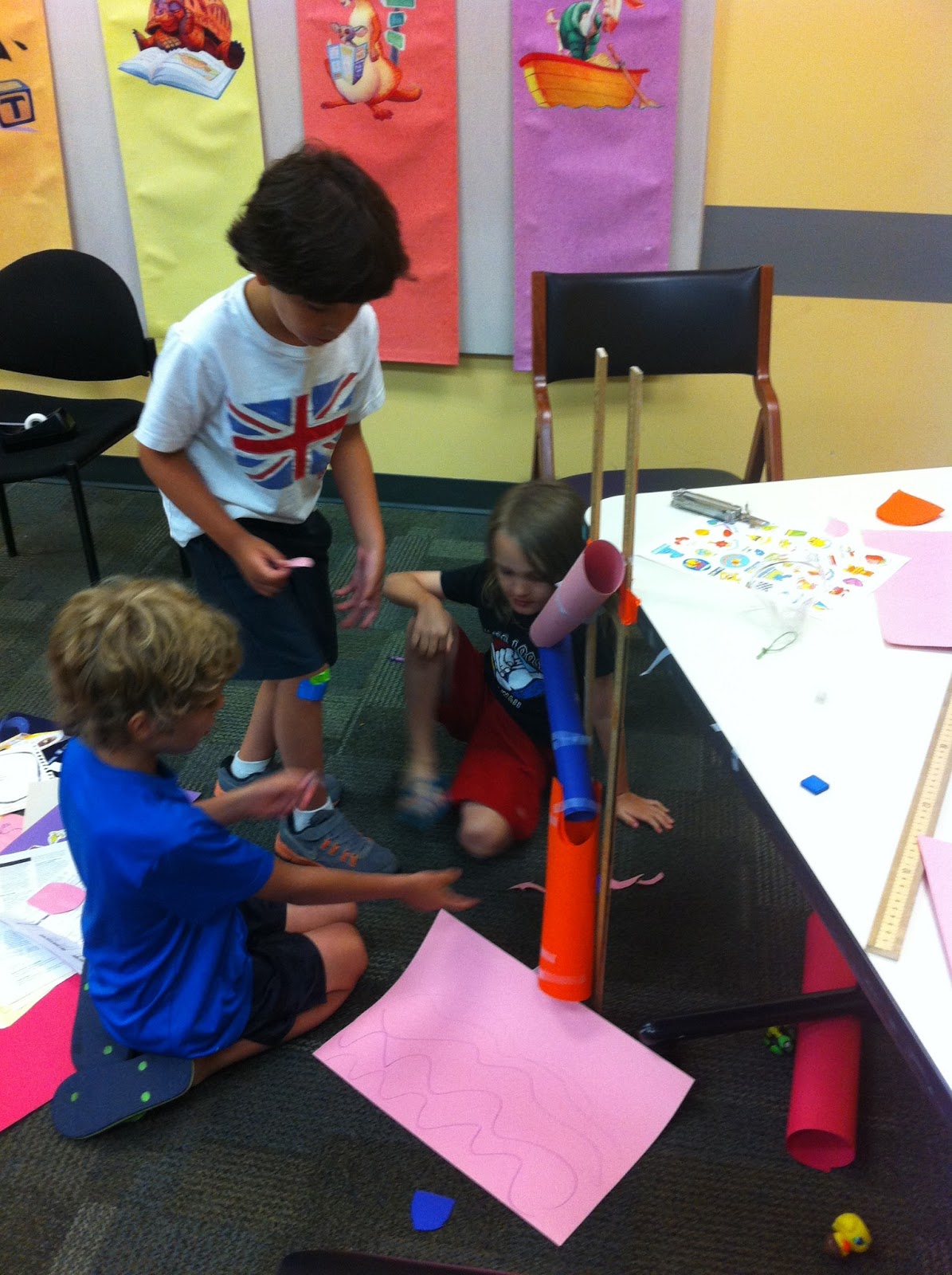
  • Students Challenged to slow the fall of a toy by creating paper cones and slides
  • Problem Solving construction, support, and function
  • Observing characteristics of objects
  • Selection of various objects sharing several characteristics
  • Game of using object characteristics to guide other students towards one object 
Coleman's Camp Studio, 2nd Week: SATURDAY
  • Three groups working on projects
  • Students helping other groups when needing a break from their group or simply interested in the work of other groups
  • Revising supply lists
  • Making progress on projects, including scripts, characters, props, and creative solutions to challenges faced during the creative process
  • Wiring electrical circuits for use by one group


Monday, April 29, 2013

Coleman's Camp - Weekly Journal Entry: 4/15/2013

Week of 4/15: The Thursday group started this week talking about Open House, which would be just an hour after the end of our session.  Kids shared some of the things they have been working on in their classrooms.  The Thursday group did a "pass-along story."  This setup was a unique way to challenge kids' writing and narrative skills.  Each kid started with their own piece of paper, writing a character introduction.  Next, we all folded our papers back to hide what we had just written, except for the last sentence, which was left visible.  We then passed our papers clockwise to the person next to us.  That kid then had to read the little bit of information left available and write about the setting of the story.  The paper was folded back again, hiding all but the last sentence.  Kids passed papers again.  We continued this process through different aspects of crafting a narrative, including introducing another character, creating a conflict, and finally having the story reach some type of resolution.  In the end we unfolded the accordion-like piece of paper and read the stories aloud.  The final product was exactly as bizarre and humorous as you might imagine, especially considering the surreal, unique, and sharp sense of humor this group exhibits.  The Thursday and Saturday groups both reviewed a packet of information received from the Omaha Zoo about the endangered animals we selected for a symbolic adoption.  The zoo had sent photographs of the actual animals we adopted, informational cards on each of the animals, a letter from the zoo about the program, and adoption certificates.  The Saturday group finished their session with game playing, allowing for some practice in sportsmanship and dealing with the frustrations of losing in games.

Sunday, April 28, 2013

Coleman's Camp - Weekly Journal Entry: 4/8/2013

Week of 4-8: With the library room unavailable at Corinth, the Thursday group met in my classroom this week.  We started by learning about my new classroom pet, Lightning Bolt, a baby bearded dragon.  Kids learned how to properly hold a bearded dragon and passed him around the group.  We then created a voice-overdub project where we selected a Disney video with a number of characters.  We watched the video several times, the volume muted, and created a new narrative to match the images.  Kids selected characters, worked up voices, and practiced improvisational skills while the video segment played.  The challenge was to create a (somewhat) coherent narrative with a beginning, middle, and end that we filmed.  The Saturday group was back at the Corinth Library for a LEGO themed challenge.  Some of the session time was spent in cooperative play, imagining and building various LEGO creations.  The second part of the session involved a challenge where kids were put into two member teams.  Team members were then separated from each other while one member created a LEGO build with 5 or 6 pieces.  The team members would then rejoin and would have to guide their partners through selecting pieces, assembling, and trying to duplicate the original piece as closely as possible.


Sunday, April 7, 2013

Coleman's Camp - Weekly Journal Entry: 3/25/2013

Week of 3-25: The absolutely beautiful weather allowed the Thursday group to be outside for half their time, playing a game called "Psychiatrist" (based off of a game I learned at Avila University during my undergraduate years).  In this game, several players have to develop lines of questioning and sort through answers that may appear contradictory or inaccurate as they face a circle of "patients" who all have the same issue.  The psychiatrist faces a circle of these patients and is given a few rules and guidelines they must keep in mind while they play, such as "every patient is being truthful and you cannot ask the patients' names."  This game allowed for intensive social skills rehearsal and practice, problem solving, and higher level/abstract reasoning.  The Thursday group also participated in a game I developed some years ago called "Tim's Toy Store."  In Tim's Toy Store, the students are provided with dozens of collectibles, toys, stuffed animals, or household items that they are largely unfamiliar with.  They are initially provided a nominal amount of start-up money (usually around $5 in actual cash) and allowed time to examine the toys and other items.  The goal is for each student to choose the item that has the most actual value; the team who selects the items worth the most money (cumulatively) wins and is allowed to select any of the items to keep, while the other teams receive nothing (or so they believe, until the end of the game).  Assigned to teams, they have some business and strategy decisions to make.  I provide them with a few "free" pieces of information that can help them sort through the toys and other items and begin determining/deducing relative value.  Then I offer levels of information for sale at leveled prices, but purchasing this information will decrease actual money (on hand).  There is a balancing act on what resources to use, when, and how much to acquire these resources.  There are a variety of other factors that can be brought in depending upon how the students are doing, their interest level, frustrations, and even individual versus group decisions.  The motivating factor is that the winners will actually win valuable items while the non-winners will not have anything.  Of course, after a review of the lessons learned and reflection on decisions, consequences, group dynamics, and use of resources, I have a reveal where everyone is allowed to take an item, with the winning team having first choice.

The Saturday group finished creating mouths and eyeballs for play-acting faces and we took a few photos of the results. They then spent the majority of their time participating in a scaled down version of the Scavenger Hunt the older Thursday kids had helped invent last week.  The scavenger hunt used the descriptive hints, the ability to blend into crowds, and decision making/problem solving skills.  Each student selected unique items from a box and then spread throughout the library in teams to hide the items.  Back in the main meeting room, Violet worked with one team while I worked with the other, brainstorming puns, riddles, clues, symbols, and even metaphors that we wrote down.  We then read the clues to the other team and set off to find the items and earn points for our team.

Saturday, March 23, 2013

Coleman's Camp - Weekly Journal Entry: 3/11/2013

Week of 3-11: The Thursday group worked with me to create a scavenger hunt based upon descriptive hints, the ability to blend into crowds, and decision making/problem solving skills.  Students would write messages on thick pieces of paper and assign point values to the lips based on how hard they would be to find.  Then they spread throughout the library, pretending to be an average patron, while they hid the paper somewhere.  Back in the room with me, they had to write riddles or clues on a different piece of paper.  We revised clues and worked to be helpful but neither too difficult nor too easy.  Once everyone had their clues finished, we would flip them over on the table and the kids would have to scan the clues, decide which ones were solvable, and then set out to find the pieces of paper.  The Saturday group investigated creating facial expressions on flip cards that allowed them to change their expressions instantaneously.  They then wrote several skits around a central idea, allowing fun improvisation of a bus ride that picked up monsters!


Thursday, March 21, 2013

Coleman's Camp - Weekly Journal Entry: 2/18/2013

Week of 2-18: The heavy snow hit our area and closed down schools and the library; my Thursday group missed this week.  However, by Saturday the library was open again and I was able to meet with the kids, who all were excited to be out of the house and doing something!  We continued to work on our tessellations, finishing drawing over the pencil tracings and then adding colors.  Kids experimented with adding in simple two-dimensional shapes repeating inside the tessellating forms they originally drew.  For the second hour we returned to the audio hide/find challenge from last week, where kids are on teams and hide things from each other.  The team members must listen carefully to recorded directions to find the objects.  The kids continue to learn how to refine step-by-step directions, give accurate and distinct descriptions, and even to anticipate the mistakes and misunderstandings of team members.


Wednesday, March 20, 2013

Coleman's Camp - Weekly Journal Entry: 2/11/2013

Week of 2-11: Both the Thursday and Saturday groups explored tessellations (http://www.tessellations.org/), creating their own shapes from simple 3x5 cards, tessellating them across a large piece of paper, and tracing over the outlines.  The time working on our tessellations also gives us time to focus on quality work, talk, and listen to music.  The Saturday group also worked on a unique problem solving activity created just for them.  Developing language skills - including descriptive abilities, accuracy, word choice, and correcting from prior mistakes - the Saturday group uses a small digital audio recorder to record directions to team members to help them find an object hidden somewhere in the room.  Kids quickly learn to be specific, use adjectives, and to think from the perspective of teammates who have no idea what the object is or where it is hidden.